
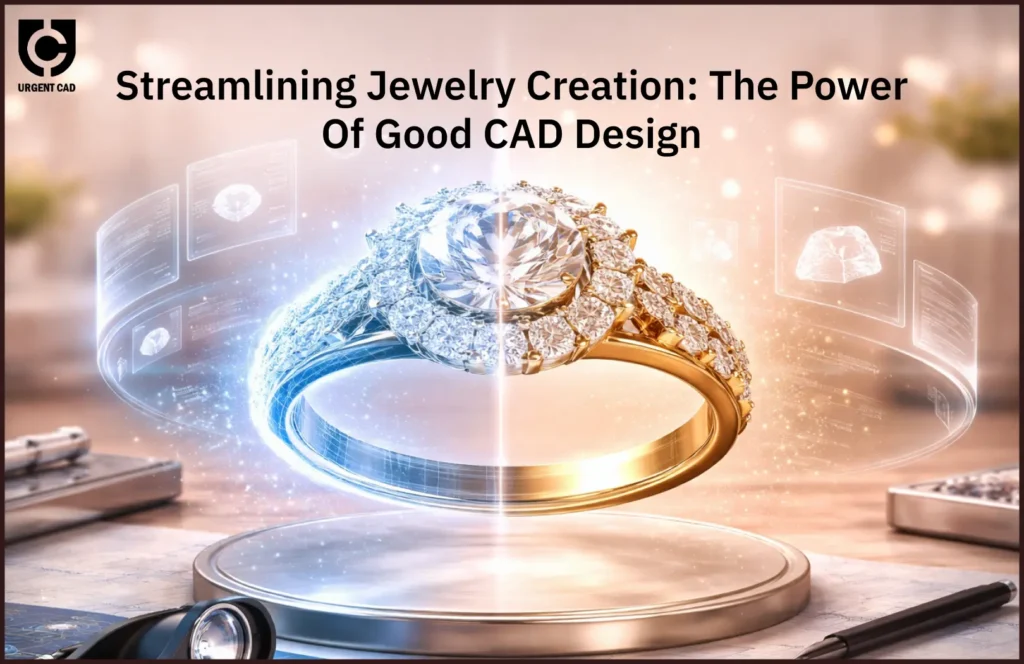
Preface to Modern Jewelry Design Evolution
jewelry CAD design has experienced a dramatic transformation over the last two decades. What once relied heavily on hand sketches, wax modeling, and repeated trial-and-error processes has now evolved into a streamlined and highly precise digital workflow. Today, designers do not just imagine jewelry they engineer it. This shift is largely driven by Computer-Aided Design (CAD), which has become the backbone of modern jewelry creation.
The demand for customization and faster delivery timelines has pushed the industry toward smarter solutions. Customers are no longer satisfied with mass-produced pieces; they want something unique that reflects their personality. This growing expectation has made traditional methods less effective, especially when precision and speed are critical. CAD bridges this gap by allowing designers to visualize, test, and perfect designs before production even begins.
Industry insights show that CAD is rapidly becoming the dominant method in jewelry manufacturing, with experts predicting it will soon become the primary process across the industry. This is not just a trend it is a fundamental shift in how jewelry is conceptualized and produced.
What is Jewelry CAD Design?
Understanding Digital Modeling
At its core, jewelry CAD design is the process of creating detailed 3D models of jewelry using specialized software. Unlike traditional sketches, these models are fully interactive and can be viewed from any angle. Designers can adjust dimensions, refine details, and even simulate how a piece will look when worn.
This level of control is a game-changer. CAD allows jewelers to define exact measurements for stones, prongs, and metal thickness, ensuring that every element fits perfectly. CAD eliminates guesswork by enabling designers to plan every detail before production begins.
From Sketch to 3D Reality
The journey from concept to creation has become significantly more efficient with CAD. It typically starts with a rough idea or sketch, which is then converted into a detailed digital model. This model can be refined repeatedly without wasting materials or time.
Once perfected, the design is used to create prototypes through 3D printing or casting processes. This seamless transition from digital to physical production ensures that the final product closely matches the original vision.
Why CAD is Revolutionizing Jewelry Creation
Precision and Accuracy Explained
Precision is everything in jewelry CAD design. A slight miscalculation in stone placement or metal thickness can compromise the entire piece. CAD eliminates these risks by providing exact measurements and tolerances.
Designers can calculate weight, balance, and structural integrity before production begins. This ensures that the final piece is not only visually appealing but also durable.
Removing Traditional Limitations
Traditional jewelry design methods often limit creativity due to physical constraints. Complex patterns, intricate detailing, and unconventional shapes are difficult to achieve by hand. CAD removes these barriers, allowing designers to experiment freely.
With digital tools, even the most intricate designs can be created and modified easily. Designers are no longer limited by what can be sculpted manually. Instead, they can push boundaries and explore new possibilities, resulting in more innovative and unique pieces.
The Role of CAD in Modern Workflows
Faster Design Iterations
Speed is a critical factor in today’s competitive market. With modern jewelry CAD design workflows, designers can make changes instantly, test multiple variations, and finalize designs in a fraction of the time required by traditional methods.
This ability to iterate quickly not only improves efficiency but also enhances creativity. Designers can experiment with different styles, materials, and configurations without worrying about time or cost constraints.
Enhanced Collaboration
Collaboration is another area where CAD excels. Digital models can be shared easily with clients, manufacturers, and team members. This ensures that everyone involved in the process is on the same page.
Clients can view realistic previews of their jewelry and request changes before production begins. This reduces misunderstandings and improves customer satisfaction.
Key Benefits of Good CAD Design
Cost Reduction
One of the biggest advantages of CAD is its ability to reduce costs. By identifying potential issues during the design phase, designers can avoid expensive mistakes during production. Material waste is minimized because designs are optimized before manufacturing.
Time Efficiency
Time is money, especially in the jewelry industry. CAD speeds up every stage of the design and production process. What used to take weeks can now be completed in days or even hours.
Creative Freedom
Creativity thrives when there are no limitations. CAD allows designers to explore complex and detailed designs that would be impossible to create manually. From intricate filigree patterns to modern geometric shapes, the possibilities are endless.
CAD vs Traditional Jewelry Design
| Feature | CAD Design | Traditional Design |
|---|---|---|
| Precision | Extremely High | Moderate |
| Speed | Fast | Slow |
| Customization | Unlimited | Limited |
| Cost Efficiency | High | Lower |
| Error Rate | Minimal | Higher |
How CAD Improves Custom Jewelry
Personalization at Scale
Customization is one of the biggest trends in the jewelry industry. CAD makes it possible to create unique pieces tailored to individual preferences without increasing production time or cost.
Customer Visualization Benefits
One of the most powerful features of CAD is its ability to create realistic previews. Customers can see exactly how their jewelry will look before it is made. This builds confidence and reduces the need for revisions.
CAD and Manufacturing Integration
3D Printing and Prototyping
CAD integrates seamlessly with modern manufacturing technologies like 3D printing. Digital models can be converted into physical prototypes quickly and accurately.
Seamless Production Pipeline
From design to production, CAD creates a smooth workflow. Digital files can be shared directly with manufacturers, reducing errors and delays while improving overall quality.
Future Trends in Jewelry CAD Design
The future of jewelry CAD design looks promising, with advancements in technology continuing to push boundaries. Emerging trends include AI-assisted design, augmented reality visualization, and cloud-based collaboration tools. These innovations are making CAD more accessible and efficient, enabling designers to create even more complex and innovative pieces.
Conclusion
Good jewelry CAD design has become an essential part of modern jewelry creation. It streamlines the entire process, from concept to production, while improving precision, efficiency, and creativity. The shift toward CAD is not just about adopting new technology it is about redefining how jewelry is designed and produced. For designers and businesses looking to stay competitive, embracing CAD is no longer optional. It is the key to delivering high-quality and customized jewelry.
FAQs
1. What is jewelry CAD design?
Jewelry CAD design is the process of creating 3D digital models of jewelry using specialized software before manufacturing.
2. How does CAD improve jewelry production?
jewelry CAD design improves production by reducing errors, speeding up the design process, and enabling accurate prototyping.
3. Is CAD better than traditional jewelry design?
CAD offers better precision, speed, and customization, though traditional methods still have artistic value.
4. Can CAD be used for custom jewelry?
Yes, CAD is ideal for custom jewelry CAD design because it allows designers to create personalized designs and show realistic previews.
5. What is modern CAD workflow in jewelry design?
Modern CAD workflows focus on faster jewelry CAD design iterations, improved collaboration, and quicker production timelines.
